 Get Care
 MyCovenantHealth Portal
- Find a DoctorDoctors by Specialty
- Cardiac Electrophysiology
- Cardiology
- Colon & Rectal Surgery
- Family Medicine
- Gastroenterology
- General & Vascular Surgery
- Gynecological Oncology
- Gynecology
- Infectious Disease
- Internal Medicine
- Interventional Cardiology
- Interventional Radiology
- Nephrology
- Neurology
- Neurosurgery
- Obstetrics & Gynecology
- Oncology
- Oncology & Hematology
- Orthopedic Surgery
- Otolaryngology
- Perinatology
- Psychiatry
- Pulmonary Medicine
- Radiation Oncology
- Rheumatology
- Sleep Medicine
- Thoracic Surgery
- Urology
- View All Doctors
- Our ServicesMedical Services
- Bariatric Services
- Behavioral & Mental Health
- Breast Care
- Cancer Care
- Critical Care
- Ear, Nose, & Throat
- Emergency Services
- Gastroenterology
- Glossary
- Heart Care
- Home Care
- Hospice & Palliative Care
- Imaging & Diagnostics
- Long-Term Care
- Nephrology
- Orthopedics
- Primary Care
- Rehabilitation Therapies
- Robotic-Assisted Surgery
- Sleep Services
- Spine Care
- Stroke Care
- Surgery Services
- Telehealth Services
- Urology
- Urgent Care
- Virtual Urgent Care
- Women’s Services
- Wound Care
- Our Locations
- Patients & Visitors
- About Us
 Back to Covenant Health Home
 Get Care
 Schedule an Appointment
 Pay a Bill
 Careers
 Contact Us
 Log In to MyCovenantHealth
Reaching and stretching, Randy Abernathy follows the movements modeled by his clinical
specialist at Covenant Health Therapy Center – West Knoxville, a department of Parkwest
Medical Center. He is tall, and when his hands reach upward they move above almost everyone
in the room.
The seemingly simple form of movement is part of a complex plan that is restoring his hope. Abernathy has multiple system atrophy (MSA), a rare degenerative neurological disorder that’s a
form of Parkinson’s disease. His first symptoms were subtle. “I was really fatigued,” Abernathy
explains. “I had to force myself to get out of bed, and then I started shuffling my feet. I knew
something wasn’t right, but I just couldn’t pinpoint it.” In a relatively short period of time,
Abernathy went from an active life of work, motorcycle mechanics and bass fishing to being trapped in his own body. He shuffled into Covenant Health Therapy Center – West Knoxville using a cane for support, and he couldn’t rise from his chair without help.
But Abernathy’s wife explains that something extraordinary happened when her husband began his physical therapy. “We could see a big difference,” Claudette Abernathy says. “Within a week or two he was walking without a cane.”
Finding the Answer
The road to diagnosis and effective treatment was a long one. When the first physician he saw suggested Abernathy might have Parkinson’s, it just didn’t sit quite right with his wife.
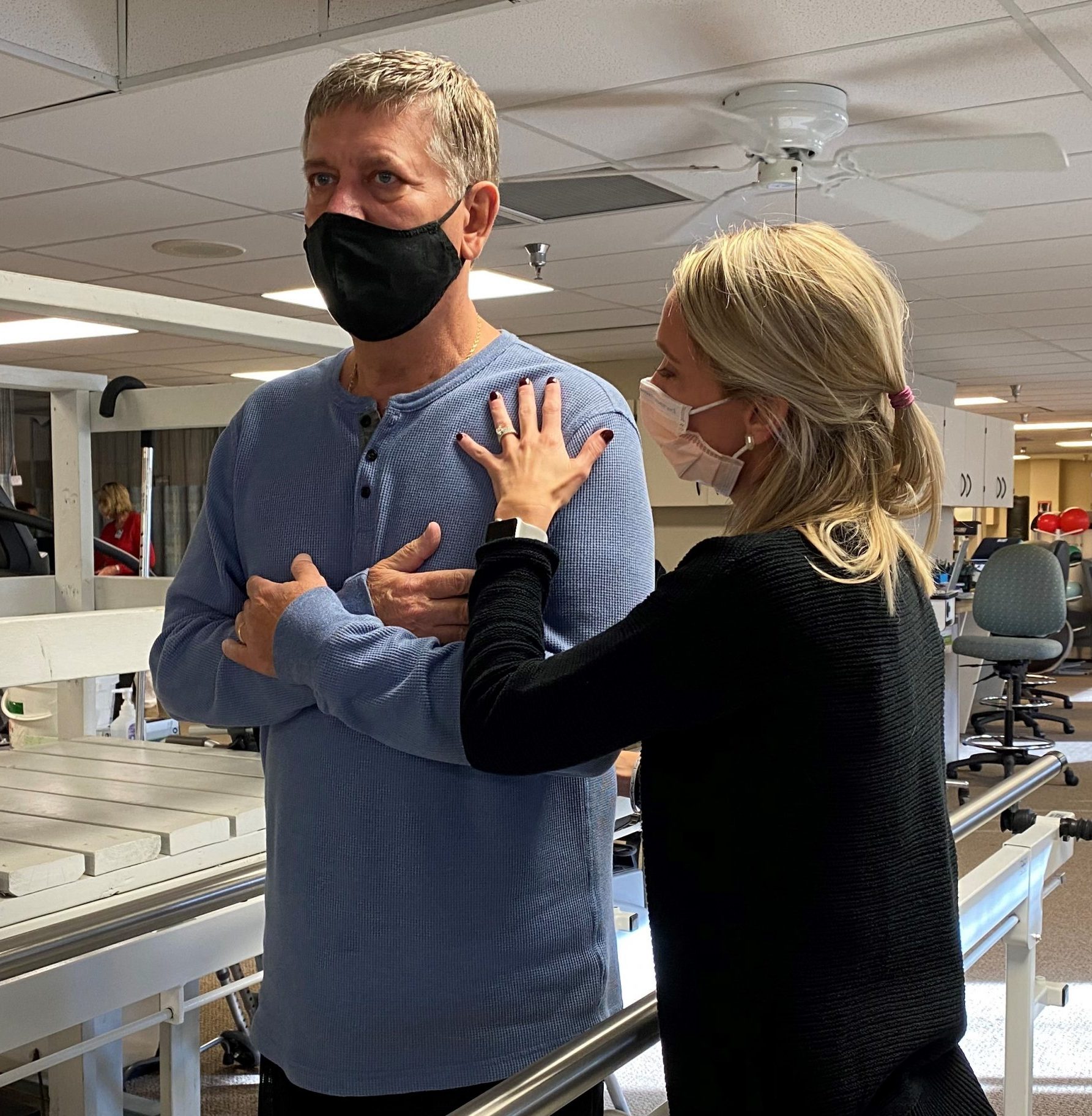
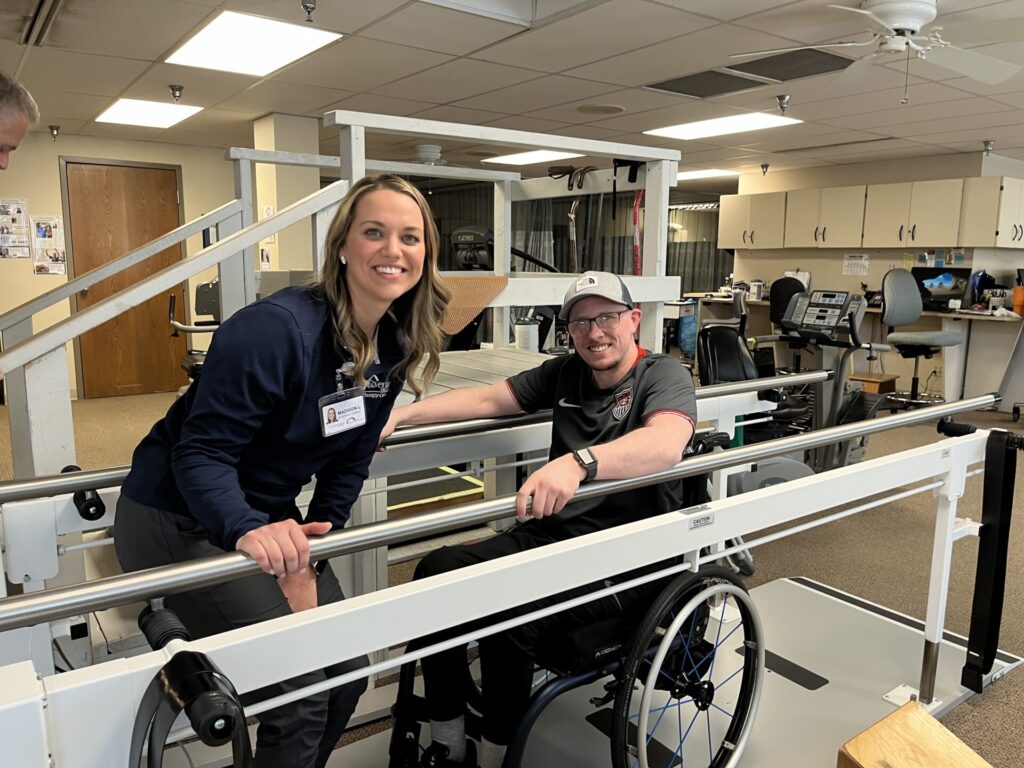
Clinical specialist Margaret Keele guides Randy Abernathy through specially designed exercises at Covenant Health – Therapy Center – West Knoxville following his diagnosis of
multiple system atrophy.
“He doesn’t jerk. He just has the shakes once in a while,’” Mrs. Abernathy says. “Then I got to
reading about multiple system atrophy.” Similar to Parkinson’s, multiple system atrophy is a neurodegenerative disorder that can cause a variety of symptoms including impaired balance and movement, poor coordination and speech difficulties.
The telltale sign for her was the bradykinesia (slow movement). While Abernathy doesn’t have
constant tremors on the out- side, he suffers the pain of tremors on the inside and all the
related effects. The pain is constant and the disability has been devastating. The therapy has been life-changing.
BIG and LOUD
Clinical specialist Margaret W. Keele says the LSVT “BIG” and “LOUD” course of therapy at Covenant Health Therapy Center – West Knoxville includes exercises specifically designed for people who have Parkinson’s dis- ease. Keele works with the “BIG” part of the program, which is the physical side. “The purpose is to use large, high amplitude movements and teach patients ‘normal’ movement,” Keele says. “We incorporated a lot of walking and balance into his treatment, and we worked on a lot of uneven surfaces because he loves to do things outdoors.”
During their time together at Covenant Health Therapy Center – West Knoxville, Abernathy heard Keele say the same thing over and over again. “Stand tall!” Keele said.
This gentle reminder helped Abernathy fight back against his tendency to stoop into the
disorder. His therapy included a lot of movements to help him regain the ability to do simple
things like eating and dressing.
Speaking Up
LSVT “BIG” and “LOUD” also includes a speech therapy component. “Parkinson’s is a movement disorder, and these movements include those needed to generate speech,” says Abernathy’s
speech therapist Jenna Whipple. When Abernathy began speech therapy, he could barely speak above a whisper. Today, he can easily be heard and understood.
“The LSVT ‘LOUD’ program includes specific voice exercises that target respiratory support, vocal quality, vocal endurance and vocal loudness, as well as patients’ perception of how they communicate,” Whipple says. “Exercises and therapeutic tasks are patient-centered and specific in order to have the greatest impact and carryover of progress outside the therapy room.”
Quality of Life
Multiple system atrophy will always be a challenge for Abernathy. He has to put thought into movements that most of us make automatically, like telling his feet to move be- fore he can
go for a walk.
With help from Covenant Health Therapy Center – West Knoxville, Abernathy believes he’s up to
that challenge. That’s why the Abernathys are going public with their very personal struggle.
They want to help others who may be working through this mystery disorder. They also want
to call attention to the hope that Covenant Health Therapy Center – West Knoxville can bring. “They care about what the outcome is,” Abernathy says. “When I walk out of here, Margaret will follow up on me. You get that feeling that she really cares. And Jenna, she’s the same way.”
His wife agrees. “To me they are the most qualified and caring therapists we’ve ever dealt
with.” For more information about the services available at Covenant Health Therapy Center visit
Covenanthealth.com/covenant-therapy-west-knoxville or call us at (865) 531-5710.
A Rare Disorder
Multiple system atrophy(MSA) is a neurodegenerative disorder that can cause a variety of symptoms. Impaired balance and movement, poor coordination, bladder dysfunction, sleep disturbance and changes in blood pressure can all be attributed to MSA.
It’s common for MSA patients to be misdiagnosed for having regular Parkinson’s disease,
but MSA has some unique features that set it apart. MSA affects several areas of the brain,
including theare as that control balance and coordination, and the autonomic nervous system. MSA also involves different types of cells.
Randy Abernathy noticed fatigue first, and his wife noticed it, too. “He just kept getting
more tired – I mean, to where he could hardly go,” says Claudette Abernathy. “It varies from week to week,” says Abernathy.
“Swallowing – I have to watch what I eat and drink. I have to use a straw. I have to hold my head down or I get choked real easy.” The most common first symptoms of MSA are light-headedness, dizziness and fainting spells, although sometimes other symptoms appear first. Difficulty initiating movement, body stiffness, urinary incontinence and increased falls can also be initial symptoms. MSA impacts the autonomic nervous system, so many patients can have problems with blood pressure, body temperature, digestion, urination and sexual function.
Sleeping abnormalities such as snoring and apnea, stridor (a vibrating noise caused by obstruction of the larynx or windpipe) and acting out dreams can often signal MSA. There may be slight changes to a person’s speech, like a different pitch or a voice that quivers.
Scientists believe it is “sporadic,” meaning no genetic or environmental factors have been
found to cause MSA. Patients who have MSA tend to experience symptoms at a younger age than those who have Parkinson’s disease, usually in their early 50s. Medications and lifestyle changes can help manage symptoms, but there is no cure.
When Abernathy began physical therapy at Covenant Health Therapy Center – West Knoxville, he had been told he would be in a wheelchair by January 2021. But physical therapy has him on his feet, able to help around the house and
enjoy his grandchildren. “It’s even helped with my fatigue and it’s helped with my speech,” Abernathy says as he gets ready for more exercises at the therapy center. “ MSA changed my life. But I’m still walking, thanks to this place.”
If you suspect you or a loved one may be experiencing symptoms of MSA, the first step is to see
your doctor. For help finding a physician, call (865) 541-4500 or toll-free at (877)334-4500.