Proton Therapy
Our Region’s ONLY Proton Therapy Treatment Center

Covenant Health Proton Center offers patients one of the world’s most advanced forms of cancer treatment right here in Knoxville.
Proton therapy is a trusted form of radiation therapy capable of precisely targeting tumors while significantly sparing healthy tissue and decreasing the risk of side effects. Our facility is located in Knoxville, Tennessee.
Why You Should Consider Proton Therapy
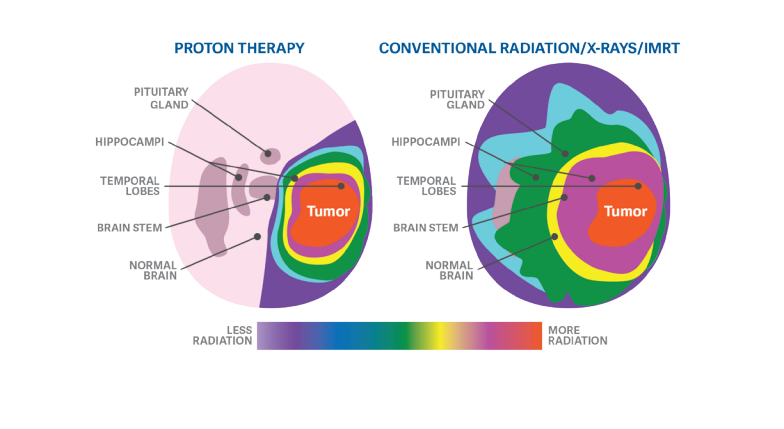
The unique characteristics of protons allow doctors to determine and plan exactly where the prescribed, maximum energy of the proton beam is released within the target tumor site to destroy cancer cells. Tightly conforming to the shape of the tumor site avoids delivering unnecessary radiation to nearby healthy tissue and vital organs. The decrease in unnecessary radiation results in patients’ improved quality of life both during and after treatment.
Cancers We Treat
Proton therapy can be the ideal treatment option for many types of cancer, including:
- Base of Skull, Brain, and Other Central Nervous System
- Breast
- Esophageal
- Head, Neck,, and Oral Cancer
- Liver
- Lung
- Lymphomas
- Pediatric
- Prostate
- Re-irradiation
How Does It Work?
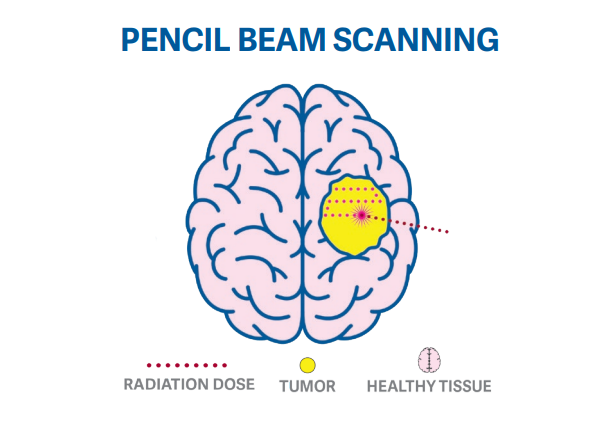
Covenant Health Proton Center uses the most advanced type of proton therapy, called pencil beam scanning. It works like a tiny, precise beam. Only a few millimeters wide, it targets a tumor layer by layer.
Doctors can control exactly where a proton beam releases its energy inside a tumor to kill cancer cells. The beam is shaped to match the tumor closely, which protects the healthy tissue and organs nearby from getting radiation they don’t need.
Proton therapy works best when cancer hasn’t spread, when a tumor can’t be removed by surgery, or when the tumor is near a sensitive organ. It can also be used alongside surgery or chemotherapy.
Treatment Advantages
Proton therapy can have several advantages for patients, including:
-
- Controlled timing, placement and dosage
-
- Improved quality of life, during and after treatment
-
- Lowers risk of side effects and impact on bodily functions
What to Expect
Because proton therapy is non-invasive with fewer side effects, most patients maintain their normal quality of life during treatment. Here are your steps to get started:
- Get Connected: Ask your doctor for a referral or call us directly at 865-862-1600.
- Consultation: A radiation oncologist will review your records, examine you, answer questions and recommend the best treatment for your unique case.
- CT Simulation: Before treatment begins, you’ll have a CT scan so our team can precisely map and plan your personalized treatment.
- Treatment: Your care team will walk you through your schedule and monitor you closely throughout treatment. You’ll meet weekly with your radiation oncologist and have access to dietitians, nurse navigators, social workers and more.

Learn More
- Download our brochure to learn more about proton therapy at Covenant Health Proton Center.
- Ask your physician if proton therapy is an option for treating your cancer or call the Covenant Health Proton Center at 865-737-1901.
- Visit our Proton Therapy Center. We offer weekly tours of our state-of-the-art facility. You’ll learn about the history and science of proton therapy and see the cutting-edge technology we use every day to save lives. To learn more or schedule a tour, complete the form below, or call 865-331-8722.
Covenant Health Proton Center has met the standards of performance of the ASTRO Accreditation Program for Excellence

Frequently Asked Questions
What is proton therapy treatment?
Proton therapy is one of the most advanced ways to deliver radiation treatments to cancerous tumors. A beam of high-energy protons is delivered with pin-point accuracy to the exact size, shape and depth of the tumor. This kills the cancer while sparing healthy tissue in the area from unnecessary radiation, therefore decreasing the risk of side-effects.
What is the difference between proton therapy and traditional radiation therapy?
Proton therapy is an advanced type of external beam radiation therapy. As with all forms of radiation therapy, proton therapy destroys cancer cells’ ability to grow and divide by damaging the cells’ DNA and causing them to die. Unlike radiation therapy that uses x-rays, proton therapy uses a beam of high-energy protons delivered directly into the tumor.
Protons stop and deposit all of their energy at the target site, eliminating the unnecessary radiation to healthy tissue. Traditional forms of radiation therapy use x-rays (photons), which deposit energy continuously from entering the body, through and beyond the tumor being treated into surrounding healthy tissue on the way to exit the body. Exposing healthy tissue to this unnecessary radiation can result in damage which creates side effects.
What are the advantages of proton therapy?
Proton therapy enables physicians to precisely determine the shape, size, depth and dose of treatment to effectively treat tumors while avoiding and eliminating damage to nearby healthy organs and tissues. Reducing or eliminating unnecessary radiation to healthy tissue improves quality of life during and after treatment by reducing the side effects.
Am I a candidate for proton therapy?
The only certain way to know if proton therapy is the best option for your cancer treatment is to speak with a proton-experienced radiation oncologist. Generally, if you have been diagnosed with cancer and told you need radiation, then proton therapy may be right for you. To schedule a consultation with a radiation oncologist, call our cancer care experts at 865-862-1600.
Can children receive proton therapy?
Yes. The American Society of Radiation Oncology concludes the benefits of proton therapy may be even greater for pediatric patients. Children’s tissue and rapid cell growth and turnover are very sensitive to radiation. This makes the precision of proton therapy beneficial to avoid long-term side effects.
What is the treatment like for proton therapy?
The proton therapy treatment team works to make your treatment as comfortable as possible. A team of radiation therapists will take you to the treatment room and use positioning cushions and tools to help you find a comfortable position. You can request music during your treatment. Total treatment time is about 20 to 30 minutes per session. While the beam is only on for a few minutes, the remaining time is used for preparation and position.
How long does a proton therapy session last?
Total treatment time is about 20 to 30 minutes per session. While the beam is only on for a few minutes, the remaining time is used for preparation and position.
How many proton therapy sessions will I need?
Like other types of radiation treatment, proton therapy is broken up into multiple sessions. How many sessions you need depends on the type of cancer and where it is in your body. Most patients come in five days a week for four to eight weeks. Each visit is quick, and most people have few or no side effects, so it’s easy to keep up with work and everyday activities while going through treatment.
Can proton therapy be combined with other treatment options?
Yes. Cancer is often treated with several different modalities. Patients may be treated with surgery, chemotherapy, immunotherapy, targeted therapy or hormone therapy in addition to proton therapy. These treatments are combined according to the individual’s case. They can be delivered in various orders, or some may be delivered during the same time period.
Is proton therapy FDA approved?
Yes, proton therapy earned FDA approval in 1988. Proton therapy has been covered by Medicare since 1997 to treat most cancer diagnoses.
Can I meet with a radiation oncologist remotely?
Although proton therapy sessions must be completed in person, remote care visits are available for some situations. To learn more, connect with one of our cancer care coordinators at 865-737-1901.
Proton Therapy Terminology
When exploring cancer treatment options, it is important to understand the terminology. Here are definitions to some common terms you may hear throughout your proton therapy treatment.
- Brachytherapy: Radiation therapy that involves the insertion of radioactive material into the body, either directly into or near a tumor.
- Bragg Peak: The energy that is emitted from protons as they settle at the end of their path in the body. When proton therapy is used, this path ends at the tumor site. Radiation oncologists have the ability to place this rush of energy at a specific depth in the tissue in order to effectively target the tumor.
- Conventional radiation therapy: The most common type of cancer treatment, in which electrons or x-rays are used to target cancerous areas of the body.
- Entrance dose: The dose of radiation that is absorbed by healthy tissue before the radiation actually reaches its intended target, the tumor.
- Electron: The particles from an atom that are deposited during traditional radiation therapies, effective for tumors that lack depth.
- Exit dose: The dose of radiation that is absorbed by healthy tissues after the radiation actually reaches the tumor. With the use of proton therapy, protons enter the tumor and then stop, eliminating this exit dose.
- Local therapy: Cancer treatment that impacts the tumor itself and the area closely surrounding it (e.g. surgery)
- Metastasize: The result of cancer cells that split from a tumor, settle and form a new tumor in an additional location in the body.
- Pencil Beam: Feature of the proton therapy treatment unit from which the protons are administered. Allows for targeted, precise doses of radiation, minimizing negative side effects and providing a lower risk of damage to surrounding tissue.
- Protons: The particles from an atom that have a positive charge.
- Proton therapy: An advanced form of radiation therapy that uses a single beam of high-energy protons, rather than X-rays, to treat various forms of cancer, delivering precise treatment to tumors in a way that reduces negative side effects and cancer recurrence.
- Radiation therapy: Cancer treatment that involves the use of X-rays or radiation, including proton therapy.
- Simulation visit: the use of a computed tomography (CT) scan, a positron emission tomography (PET) scan, or a magnetic resonance imaging (MRI) to determine the ideal treatment plan for proton therapy patients.
- Toxicity: Damage to normal, healthy tissue as a result of exposure to radiation during treatment.
- Tumor: Caused by a concentration of cells, it is a mass that may be benign, lacking the ability to metastasize and spread to other parts of the body, or malignant, able to spread and collect in additional areas of the body.