
Covenant Health Helps Homeless Patients Recover with KARM
- 5 minute read.
- Last Updated: 7/27/2026
When patients leave the hospital, recovery often continues at home with the support of family or home health professionals. But what happens when there is no home to return to?
For individuals experiencing homelessness, the path to recovery is often far more complicated. Limited access to routine medical care can lead to repeated emergency room visits, hospitalizations and worsening health conditions. Recognizing this gap, Covenant Health Homecare and Knox Area Rescue Ministries (KARM) work together to provide better recovery options. These combine medical care with stability, dignity and hope.
A Place to Heal for the Homeless
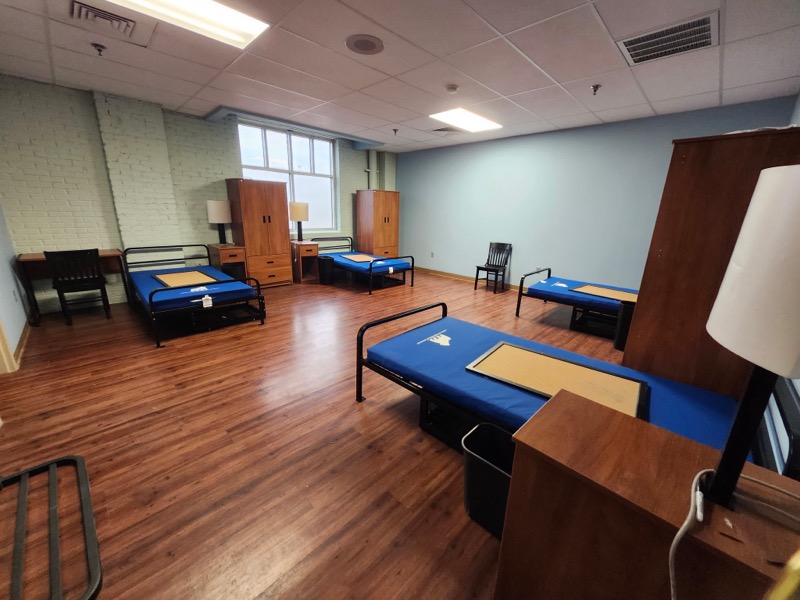
Through this partnership, patients discharged from the hospital with nowhere to recover can stay at the Homecare at KARM facility. There, they receive ongoing medical support in a safe, supportive environment.
The program began a few years ago as a 10-bed program serving men. Now, it has expanded into a 30-bed unit for both men and women. With care and clinical support from Covenant Health, the Homecare at KARM program provides patients with the opportunity to recover well from illness, injury or surgery.
As a registered nurse and wound care certified specialist with Covenant Health Homecare, Leslie Price focuses on educating patients and KARM’s clinic staff about each patient’s health needs. “If they have a wound, I teach them about signs and symptoms of infection,” Leslie explains. “I educate them on medications, including frequency and side effects, how to set up their own pill planner and how to get refills on their medications. Most have never done this before.” She tries to get patients to become independent with their own healthcare, but she admits, “some are harder than others.”
Recovery is about more than physical health. Leslie works closely with Covenant Health social worker Gina Carvagno and the broader care team to address mental health needs as well. “We’re very much of the mindset that mental health is just as important as physical health,” Leslie says. “Many of our patients struggle with anxiety, depression, schizophrenia or other mental health conditions.” They connect the patients with mental health services and provide continued support for those who are open to receiving care.
A Partnership That Changes Lives
Deborah Spencer, a manager for the Homecare at KARM program, has witnessed firsthand the impact of the partnership. “I believe we’re doing a great service with Covenant,” she says. “They develop a treatment plan, and once patients meet their goals, we begin helping them prepare for what’s next.”
Before the Homecare at KARM program existed, many patients discharged from the hospital returned to the streets while still recovering. Today, they have a safe place to heal. For many, it has become the first step toward permanent housing, employment and reconnecting with family. “We’ve reunited patients with family members, helped many move into housing and seen others find jobs after getting back on their feet,” Leslie says. In fact, from December 2025 to June 2026, the program has seen the successful transition of 17 patients to housing.
“My favorite thing about working with this population is seeing the growth they make when they realize they have someone in their corner helping them.” Leslie adds, “It’s very humbling. I love the connections I get the privilege of making. I even have some former patients that still call me to check in. It is truly the hardest, best job in the world. I wouldn’t give it up for anything!”
Stories of Hope
For both Leslie and Deborah, the program’s greatest successes are found in the lives that have been transformed. Deborah remembers one patient who initially came to KARM believing he had a severe cold. After being sent to the hospital, he was diagnosed with pneumonia. Doctors also discovered a tumor in his lung, which turned out to be stage III (3) lung cancer. The Homecare at KARM program supported him throughout chemotherapy, providing stability and encouragement during an incredibly difficult time. Then one day, he approached Deborah in disbelief. “He said, ‘They can’t find anything. I’m in remission.'” For Deborah, moments like that are the reason she comes to work every day.
Leslie recalls another patient who arrived with severe pressure wounds caused by years of living with spina bifida and using a wheelchair. Despite numerous medical complications, he maintained an extraordinary sense of humor and optimism. Last summer, the team helped him move into his own apartment. Before leaving, he made it his mission to welcome every new patient, offering friendship, encouragement and practical support. He purchased a bicycle for one resident, bought food for others and continues to stay connected with many of the people he met during his recovery. He still visits the Homecare at KARM unit to encourage patients. “Honestly,” Leslie says, “he’s become more like family to me.”
Changing Perceptions About Homelessness
Leslie hopes more people understand how quickly homelessness can happen. “I don’t think people realize how easy it is to become homeless,” she says. “A series of unfortunate events in a very short amount of time can completely turn someone’s world upside down.” She also challenges common misconceptions. “Many people assume homelessness is always the result of addiction. While addiction can certainly play a role, that’s far from everyone’s story. Some people lose a job, face overwhelming medical bills or lose a spouse and suddenly can’t afford housing anymore.” She believes the Homecare at KARM program gives people more than medical treatment. “It helps people get back on their feet and gives them a safe place where they can begin to feel whole again.”
Better Health, Better Outcomes
The partnership between Covenant Health and KARM has produced measurable improvements for patients experiencing homelessness. By providing supervised transitional care after hospitalization, the program has helped reduce emergency department visits and hospital readmissions, improve medication adherence, lower the risk of additional illness or infection and achieve better overall health outcomes.